
British lawmakers have been urged to confront the true nature of the Chinese Communist Party (CCP) after a parliamentary seminar presented detailed evidence of forced organ harvesting from prisoners of conscience in China.
The event, titled “Understanding the Chinese Leadership,” was held on July 8 at Portcullis House in London and focused on the gap between Western assumptions about China and the CCP’s actual practices.
Former Conservative leader Sir Iain Duncan Smith, who chaired the seminar, stressed the need for policymakers to understand how differently the CCP operates from democratic governments.
Jan Jekielek, senior editor of The Epoch Times and author of “Killed to Order,” told the audience that the CCP has built an industrialized system of on-demand organ harvesting. He cited the case of a German woman who received three livers in China between 2015 and 2019.
“In any ethical transplant system, vital organs typically come from catastrophic accidents,” Jekielek said. “Yet wait times in China are often measured not in years, or months—but in weeks or even days.”
He explained that this was made possible by designating groups such as Falun Gong practitioners as enemies of the state and detaining large numbers of them. Jekielek also quoted Sir Geoffrey Nice, chairman of the China Tribunal, who warned, “Governments and any who interact in any substantial way with the PRC should now recognize that they are interacting with a criminal state,” using the official acronym of China under the CCP, referring to the People’s Republic of China.
Related Stories
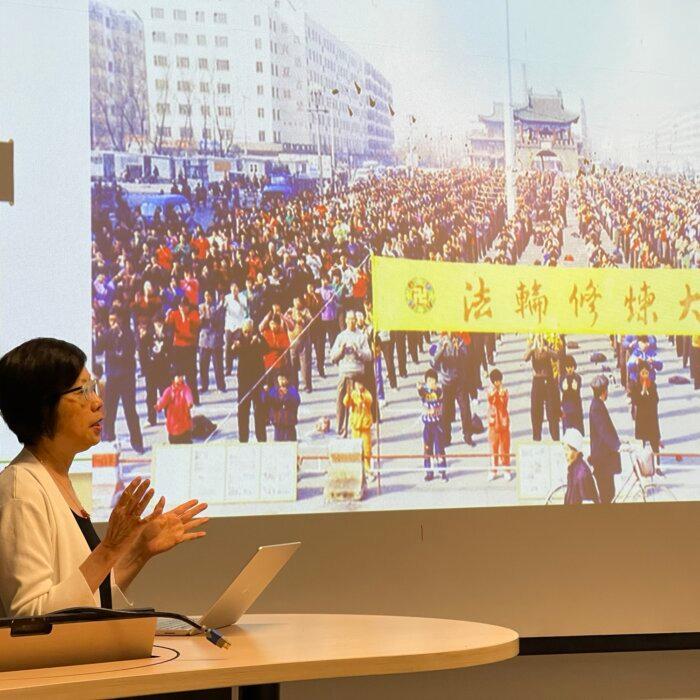
In 2019, the China Tribunal released a report, concluding that forced organ harvesting from prisoners of conscience had occurred on a substantial scale in China.
These findings led the panel to determine unanimously and beyond a reasonable doubt that the practice had been carried out for years on a significant scale, with Falun Gong practitioners being used as the main source of organs.
Canadian human rights lawyer David Matas, who spoke at the event, turned his remarks to possible changes in UK law, arguing that existing legislation contains significant gaps and shortcomings.
“The UK extraterritorial law accordingly has a gap which needs to be filled,” Matas said, particularly regarding cases where organs are given to well-connected individuals without commercial payment.
Investigative journalist Ethan Gutmann presented findings from his research on Xinjiang. Drawing on interviews with former camp detainees and refugees, he estimated significant annual disappearances.
“With 1 million in the camps, a 2.5 percent disappearance rate means 25,000 dead per year. Five percent means 50,000 dead per year,” Gutmann said. “We are looking at, at a minimum, a quarter of a million dead Uyghurs and Kazakhs, and counting.”
The seminar was organized by the UK Falun Dafa Association. As Britain prepares for a new government, the panelists called on the incoming administration to recognize the scale of the abuses and take concrete action.
The practice of forced organ harvesting in China has been investigated for nearly two decades. Matas co-authored a landmark report on the issue in 2006 with former Canadian minister, the late David Kilgour.
Chinese authorities have consistently denied the claims, stating that the country has reformed its transplant system and relies on voluntary donations.
Independent verification inside China remains extremely difficult.