
Sen. Lindsey Graham’s recent death marked the end of his role as a leading advocate for strengthening Taiwan against Chinese communist pressure.
Although Graham was better known in his final years for his positions on Ukraine, Russia, Israel, and Iran, Taiwan remained a consistent part of his foreign-policy agenda.
He visited the self-governed island on multiple occasions, supported billions of dollars in military assistance, proposed sweeping sanctions if Beijing moved against it, and argued that Washington should consider deploying American forces to defend it.
Those positions formed the substance of his reputation as a China hawk: Graham sought not only statements of support for Taiwan but also policies intended to convince Chinese leader Xi Jinping that military action would carry immediate military, diplomatic, and economic costs.
United Over Taiwan
Related Stories
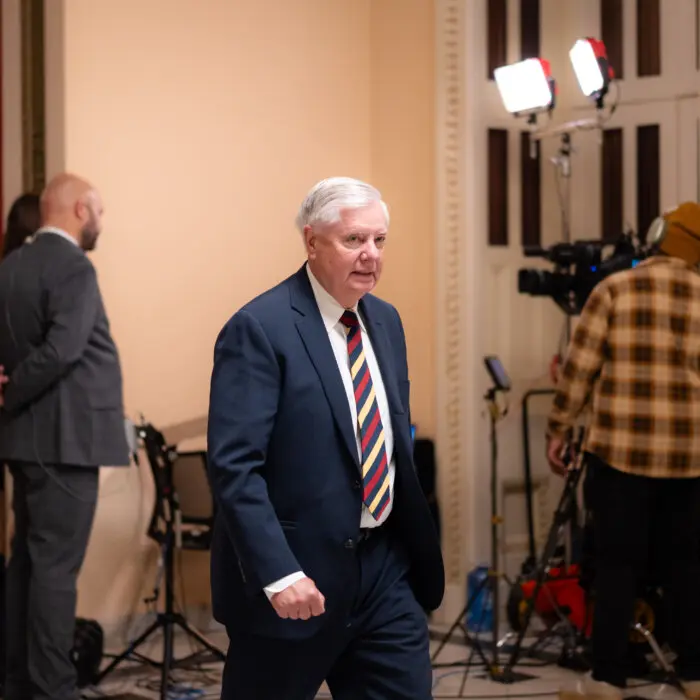
Graham told Tsai that political divisions in Washington did not extend to Taiwan.
“When it comes to Taiwan, we’re united,” he said, according to the Taiwanese Presidential Office. He associated this unity with Russia’s invasion and what he described as provocative actions by communist China.
Tsai described Graham as “a pillar of strength for Taiwan in the U.S. Congress” and cited his support for Taiwan’s international participation and stronger trade relations. She noted that he had also visited in 1999 and 2016.
During the 2022 visit, Graham said Washington sought no conflict with China. He nevertheless described the dispute as a contest between democratic government and rule maintained through force.
He also connected Taiwan’s security to American economic interests, describing the island as indispensable to the global digital economy. Taiwan produces many of the world’s most advanced semiconductors.
Sweeping Taiwan Policy Bill
Two months after the visit, Graham and Menendez introduced the Taiwan Policy Act of 2022, one of the most extensive congressional proposals to revise U.S. policy toward Taiwan since the 1979 Taiwan Relations Act.
The bill as introduced proposed almost $4.5 billion in security assistance over four years, larger additions to military stockpiles available for Taiwan, and expanded training and security cooperation.
It also proposed designating Taiwan as a major non-NATO ally, removing restrictions on contacts between U.S. and Taiwanese officials and beginning negotiations to rename Taiwan’s de facto embassy in Washington from the Taipei Economic and Cultural Representative Office to the Taiwan Representative Office.
Another part would have established a broad sanctions framework targeting Chinese officials and institutions if Beijing undertook hostile action against Taiwan.
Graham described the measure as the largest expansion of U.S.–Taiwan military and economic relations in decades.
“Our response should be that we are for democracy and against communist aggression,” he said when the bill was introduced.
“China is sizing up America and our commitment to Taiwan,” he added. “The danger will only grow worse if we show weakness in the face of Chinese threats and aggression toward Taiwan.”
The Senate Foreign Relations Committee later approved an amended version. The committee said its central purpose was deterrence—raising the expected cost of an attack while strengthening Taiwan’s ability to defend itself.
The Taiwan Policy Act did not become law under its original name or with all of its provisions intact. Its more diplomatically sensitive proposals—including designating Taiwan as a major non-NATO ally, pursuing the renaming of Taiwan’s de facto embassy in Washington and establishing a broad sanctions framework—were not enacted in their original form.
Many of the bill’s central security provisions survived.
The enacted legislation authorized up to $2 billion a year in Foreign Military Financing grants for Taiwan from fiscal year 2023 through 2027, for a five-year total of up to $10 billion, subject to conditions including certification that Taiwan had increased its defense spending.
It also created a Foreign Military Financing loan program, authorized up to $1 billion a year in presidential drawdown authority for Taiwan, and called for a comprehensive military training program and multiyear planning between the United States and Taiwan.
Those figures were authorizations rather than guaranteed appropriations. After the bill passed, Senate Foreign Relations Committee leaders said Congress would still need to fund the authorities.
The final law did not enact the Taiwan Policy Act’s full diplomatic and sanctions architecture. It did, however, place much of its proposed framework for strengthening Taiwan’s defenses into federal law.
Pre-Invasion Sanctions
Graham’s approach went beyond imposing penalties after a conflict began.
He proposed a new Taiwan defense supplemental and what he called “pre-invasion sanctions from hell” that could be imposed if Beijing took steps to seize Taiwan.
The phrase captured a recurring part of Graham’s foreign-policy doctrine: adversaries should be confronted with specified costs before they resort to force, rather than relying primarily on punishment afterward.
He also said the outcome of Russia’s war against Ukraine would influence Beijing’s calculations.
After returning from the 2022 Taiwan delegation, Graham said that a Russian success in Ukraine would make a Chinese invasion of Taiwan more likely, while a Russian defeat could prompt Beijing to reconsider.
From Ambiguity to Possible US Intervention
Graham’s Taiwan position was more explicit than the longstanding U.S. practice known as strategic ambiguity.
Under that approach, Washington does not state definitively whether American forces would intervene if Beijing attacked Taiwan. The policy is intended to deter Beijing while also discouraging unilateral changes to the status quo.
He said the United States should keep an open mind about deploying forces to defend the island because Taiwan’s survival was in America’s national security interest.
That did not amount to legislation authorizing military intervention, nor did it represent the official position of the U.S. government. It did place Graham among lawmakers advocating a more direct warning to Beijing about the possible American response.
Graham simultaneously said he supported Washington’s “one-China” policy, under which the United States recognizes the government in Beijing while maintaining unofficial relations with Taiwan. He paired that position with repeated demands that Taiwan retain the means to resist coercion or attack.
Taiwan, officially the Republic of China, has its own elected government, military, and currency. Beijing claims the island as part of its territory and has never ruled out using force to bring it under its control. The Chinese Communist Party has never governed Taiwan.