
BRUSSELS—German AfD MEP Christine Anderson described forced organ harvesting as a “profound violation of human dignity” and urged the European Union to act on reports of the practice in China.
Anderson made the comments at an April 21 conference on transplant ethics convened by the lawmaker and the Europe of Sovereign Nations Group held at the European Parliament in Brussels.
In her opening remarks, Anderson said the forced organ harvesting “strikes pretty much at the very heart of our shared values, the protection of human life, the integrity of medicine, and the defense of fundamental human rights and bodily autonomy.”
She introduced two speakers: Dr. Trevor Stammers, former associate professor of medical ethics at St. Mary’s University in the United Kingdom and author of “The Ethics of Global Organ Acquisition,” and Dr. Andreas Weber, a trauma surgeon formerly attached to the German Foundation of Organ Transplantation and current deputy director of Doctors Against Forced Organ Harvesting Europe.
Weber’s 5 Pillars of Evidence
Weber devoted his presentation to what he described as a systematic practice of organ procurement from prisoners of conscience in China.
To counter Beijing’s rebuttal that such accusations are “groundless,” he laid out what he called five pillars of evidence: witness testimonies, annual transplant numbers, statistical anomalies in the Chinese allocation system known as COTRS, exceptionally short waiting times for transplants, and the rapid expansion of transplant infrastructure, which he said grew eightfold between 2006 and 2015.
“In countries like the U.S., United Kingdom, or Denmark, about 1 percent of the actual people listed on the organ donation lists are realized as a transplant,” Weber said. “In China, it’s not 1 percent, it’s 12 percent. So if you do the equation again, this system is about 1,100 percent more effective than the other system. And this is highly suspicious and completely implausible.”
Related Stories

He added that waiting times in China, sometimes “1 to 2 days” for a double lung transplant during the COVID-19 period, contrast with delays of “about half a year” in the United States and “2 to 3 years” in Germany.
Weber recounted the case of a German patient with a rare blood type and a history of alcoholism who, unable to obtain a liver through Eurotransplant, traveled to China three times and received three livers at a reported cost of $400,000 each. The transplants all failed, he said, but the figures illustrated the financial pull of what he called “a $9 billion industry.”
Weber noted that the European Parliament has adopted three resolutions on the issue, and that in 2021, United Nations human rights experts raised alarm over reports of forced organ harvesting targeting Falun Gong practitioners, Christians, Tibetans, and Uyghurs detained in China. Neither body, he said, has followed up with substantive action.
Both institutions have called on Beijing to allow independent monitoring of these reports of systematic, state-sanctioned abuses. The Chinese Communist Party (CCP) has consistently refused such access.
‘Moral Decline’
Weber pointed to an alignment of incentives. Doctors, brokers, and hospital administrators act for profit, he said, while the CCP has a strategic interest in using transplantation to “eradicate Falun Gong.”
Falun Gong, also known as Falun Dafa, is a spiritual practice centered on the principles of truth, compassion, and tolerance. Introduced to the public in China in the early 1990s, it gained widespread popularity, reaching between 70 million and 100 million practitioners by the end of the decade, according to official estimates at the time.
In July 1999, the CCP, fearing that Falun Gong’s popularity threatened the regime’s power, launched a brutal campaign to eradicate the practice. Since then, many have suffered arbitrary detention, forced labor, torture, and death.
Weber also said nine transplant centers have been built in the Xinjiang region alone, adding that Middle Eastern demand for “halal organs” had created a specific market for Uyghur Muslims’ organs.
“The biggest threat to the medical community and to mankind as a whole,” Weber said, “is the moral decline.”
He called on the European Commission to take a public stance on forced organ harvesting and to pursue investigations in China.
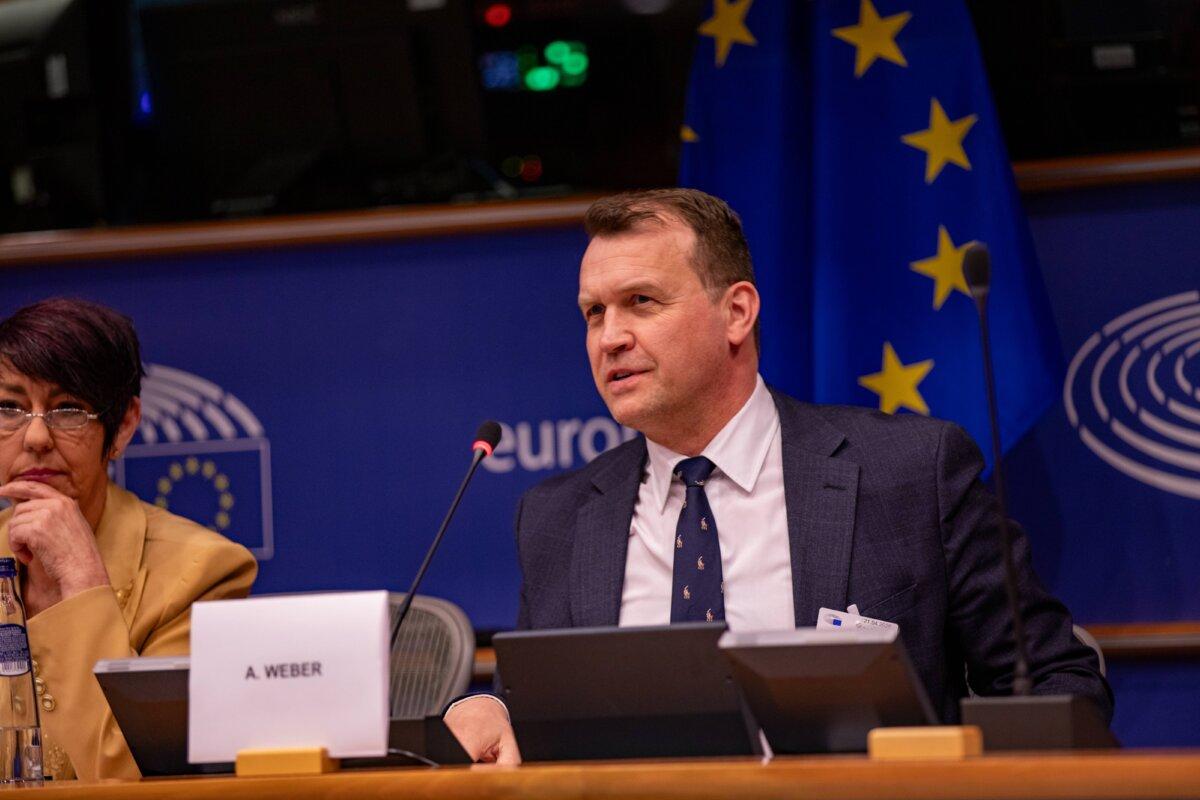
Dr. Andreas Weber on April 21 at the EU Parliament in Brussels. Fabian Wiesinger/Courtesy of ESN
Stammers, while focusing primarily on Western consent regimes, framed global organ trafficking as a product of systemic scarcity and weak accountability.
Recalling a panel in Sydney roughly a decade ago, he said an Australian transplant surgeon, just back from a teaching visit to China, had become “visibly uncomfortable” when the Chinese transplant record was raised.
Stammers also warned against opt-out systems as a remedy for donor shortages. Under such schemes, citizens are presumed donors unless they register a refusal. Spain, often cited as the textbook success, owes its high rate not to its opt-out law but to dedicated hospital infrastructure that converts every voluntary donation, he argued.
Anderson: A Question of Standards
Asked whether the European Parliament could introduce legislation similar to the bill put forward in March by Senator Ted Cruz, which would sanction individuals who “have knowingly and directly engaged in or facilitated forced organ harvesting” in China, Anderson was doubtful.
“I don’t think we would be able to do it at this time, because the House is still too far-left leaning,” she said. “And they would rather not offend China than do the right thing. But it would be a good thing to do.”
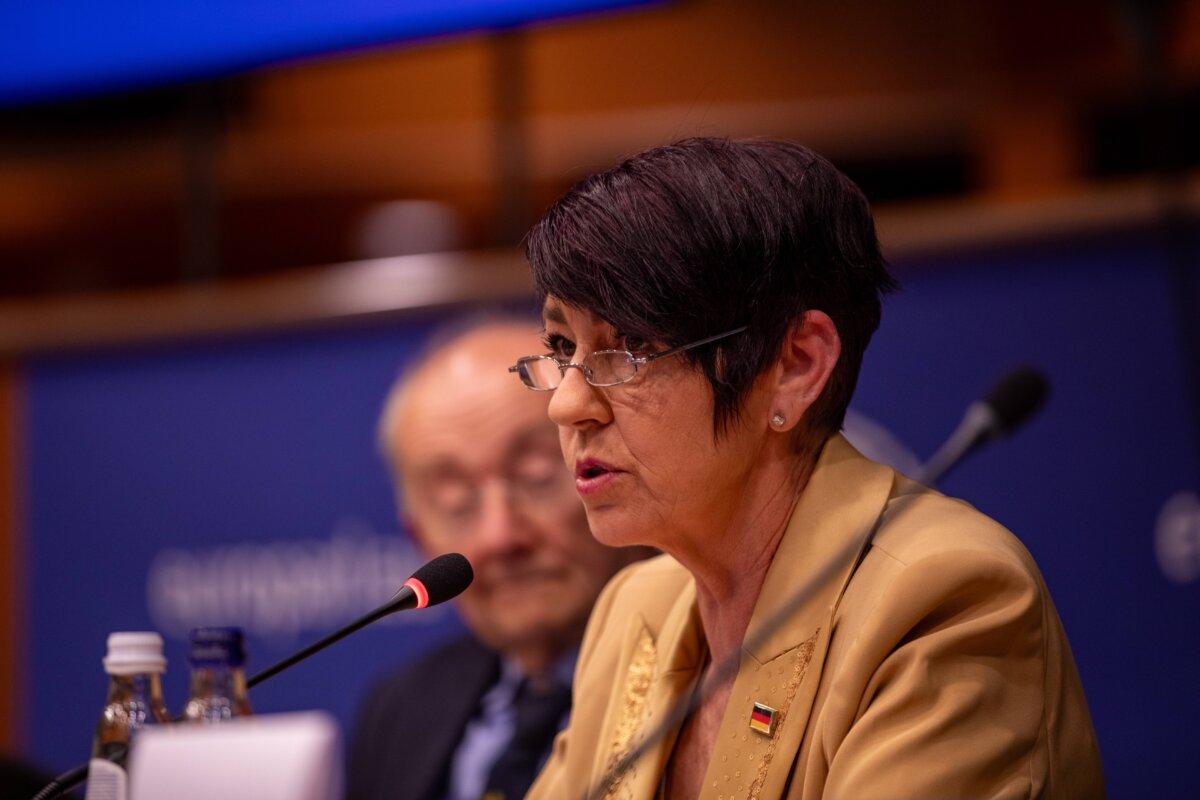
MEP Christine Anderson on April 21 at the EU Parliament in Brussels. Fabian Wiesinger/Courtesy of ESN
In an interview with The Epoch Times, Anderson said China had “perfected the system in organ harvesting by dehumanizing minorities, imprisoning them, sending them to labour camps, and harvesting their organs.”
“The figures are staggering,” she added. “So where do they get the organs from? Either they’re fudging the numbers, or they have found other ways of sourcing organs.”
On Germany’s opt-out system, Anderson denounced a “complete undermining of our bodily autonomy.”
“The state now requires me to explicitly declare that I do not wish to donate my organs,” she said. “And even that isn’t a given.”
“If organs have become a commodity, so have human beings become a commodity,” she added.