
The Chinese military fires a rocket into the air as it conducts military drills on Pingtan Island, which sits across the Taiwan Strait from Taiwan, in eastern Fujian Province, China, on Dec. 30, 2025. Taiwan faces military pressure from China, which claims that the island should fall under its governance, despite it never ruling the island. Adek Berry/AFP via Getty Images
Taiwanese ships off the east coast should ignore boarding and inspection demands by China’s coast guard, and the island’s coast guard vessels will intervene to stop this from happening if necessary, a senior official said on Wednesday.
China considers democratically governed Taiwan to be its own territory, and last month sent coast guard ships into the sea off the island’s east coast for what it termed a “special maritime traffic law-enforcement operation.”
Beijing said the operation was in response to an announcement by Japan and the Philippines that they would open talks on their maritime boundaries, which the Chinese regime viewed as affecting its waters off Taiwan.
The Chinese Communist Party (CCP) has said repeatedly that the waters around Taiwan are Chinese and that Taipei has no sovereignty of its own as it considers the island to be a renegade province and has never ruled out the possibility of using force to seize it.
China Has ‘No Jurisdiction’
Hsieh Ching-chin, deputy head of Taiwan’s coast guard, said in Parliament that if an “incident” happened in those waters, ships should notify the country’s coast guard and “not respond to the so-called boarding inspections by Chinese vessels.
Related Stories
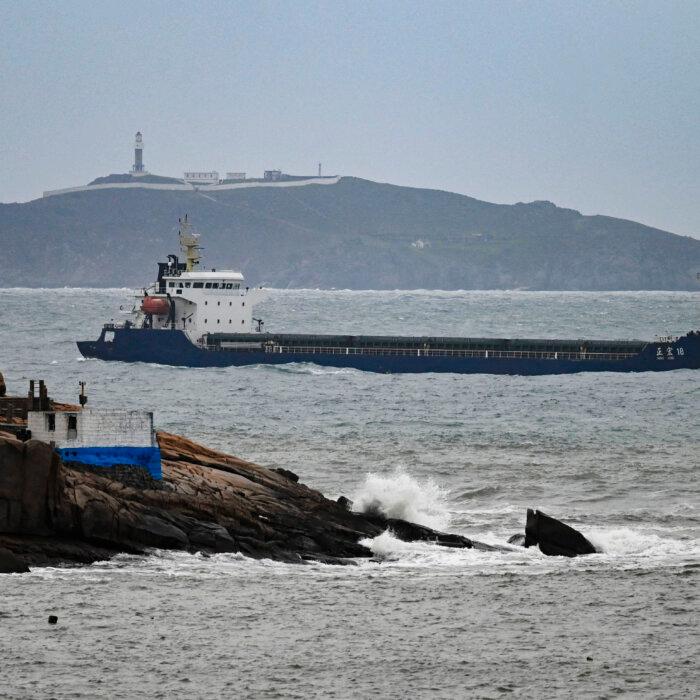

“If the situation is urgent, Coast Guard vessels will sail between the two ships to separate them,” he added, referring to Taiwanese ships.
China’s Taiwan Affairs Office has not commented.
Hsieh said that if such a request were made to a foreign-flagged ship inside Taiwan’s waters, then “in order to defend our national sovereignty and maintain order in our waters, we will intervene.”
“In our waters, China has no jurisdiction,” he added.
European and US Concerns
China’s patrols off Taiwan’s east coast have prompted concern from the United States, the UK, France, and Germany.
Neither China nor Taiwan reported any boarding requests during last month’s Chinese patrol.
However, Taiwan accused the Chinese coast guard ships of harassing commercial shipping by demanding information about their points of origin and destination and claiming jurisdiction.
In 2024, Chinese personnel briefly boarded a Taiwanese tourist boat near Taiwan-controlled islands next to the coast of China.
Taiwan said last month’s Chinese patrols are part of a broader pattern of behavior designed to intimidate Taipei, demonstrating how the CCP is shifting its tactics from purely military activity to quasi-civilian or “gray zone” operations.
China is now employing a variety of vessels, including ocean survey ships, to carry out routine operations, not just around Taiwan but also the Taiwan-controlled islands of Pratas and Itu Aba in the South China Sea, according to a report to lawmakers by Taiwan’s coast guard.
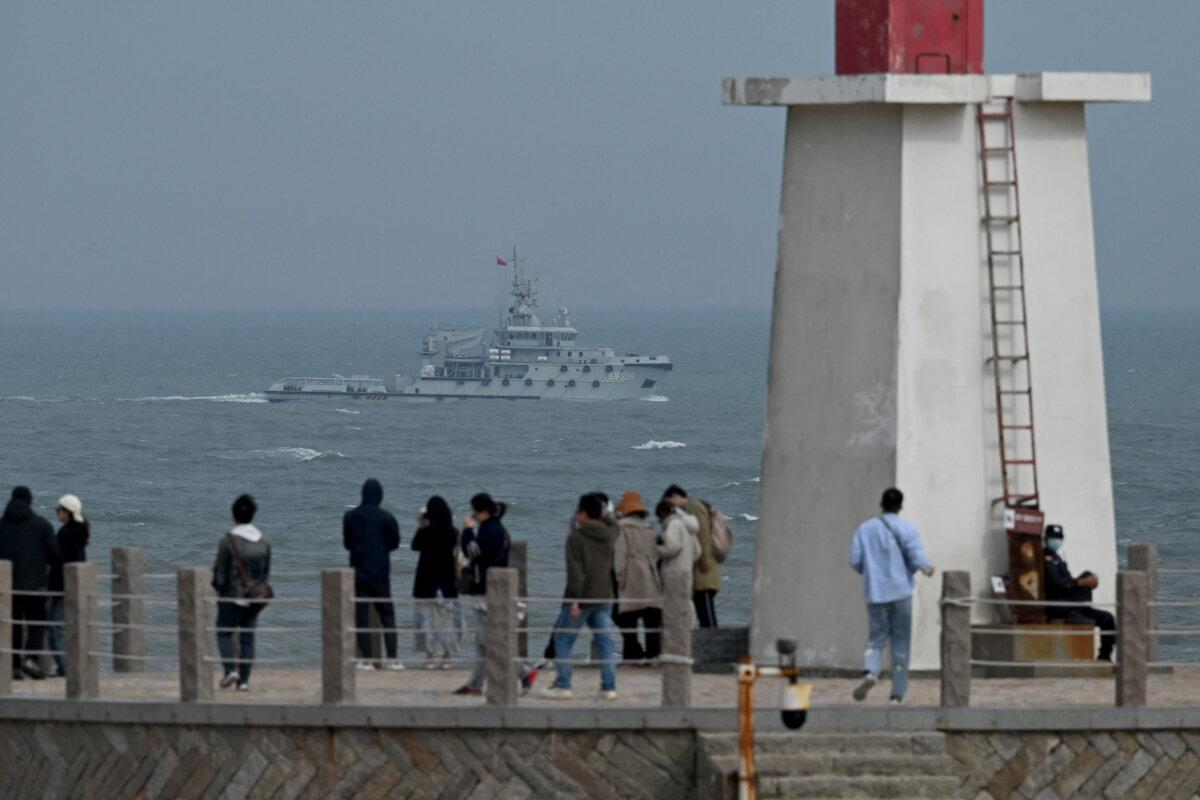
A Chinese navy tugboat sails in the Taiwan Strait, past tourists on Pingtan Island, the closest point to Taiwan, in southeast Fujian Province, China, on April 7, 2023. Greg Baker/AFP via Getty Images
‘Gray-Zone Harassment’
This “reflects a pattern of gray-zone harassment that is multi-point, multi-form, and cross-regional across maritime areas,” the report said.
“We will take all necessary measures to defend national sovereignty and maritime security, and to ensure the freedom and safety of vessel navigation.”
According to a report published on June 26 by U.S. think tank the Institute for the Study of War (ISW), China “may be aiming to alter the status quo in the West Pacific by expanding its regular law enforcement and research activity to the waters east of Taiwan.”
The ISW says that China is likely aiming “to erode Taiwanese sovereignty and establish itself as the sole legitimate caretaker” of what it considers its own maritime boundaries, including those around Taiwan and its outlying islands, sometimes referred to as the first island chain.
These islands extend from Japan through Taiwan and the Philippines to Borneo, forming a natural maritime barrier between the East Asian continental shelf and the open Pacific Ocean.
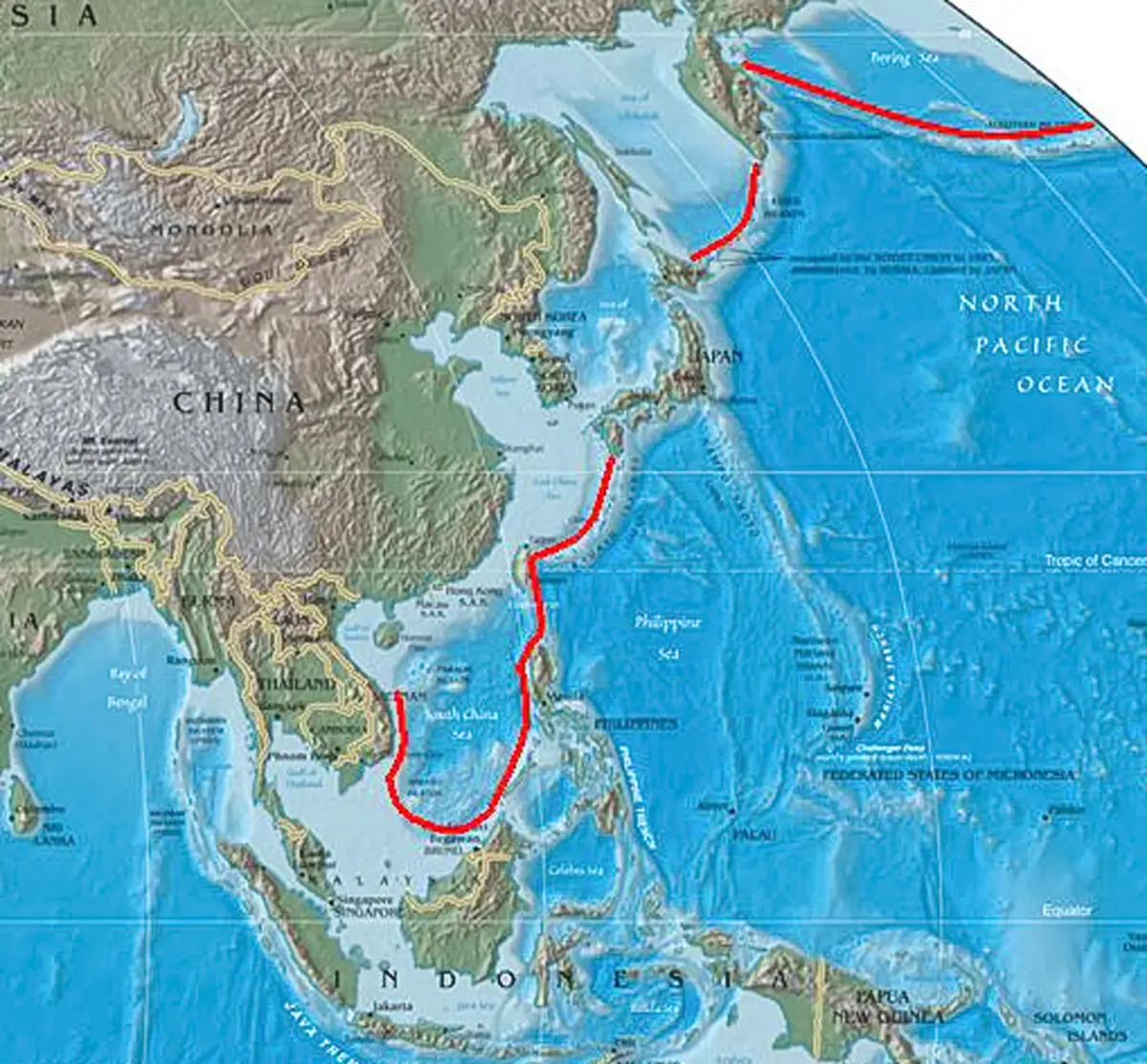
The first island chain (marked in red) is shown in this map dated April 10, 2012. Taiwan sits at the center of the first island chain—a concept in maritime strategy involving a strategic arc stretching from Japan through the Philippines to Indonesia—that acts as a barrier, constraining China’s ability to project its naval and air power into the wider Pacific. Suid-Afrikaanse/CC BY-SA 3.0
The report says that Chinese vessels have patrolled east of Taiwan “almost continuously” since June 1, according to ship-tracking data analyzed by ISW from Starboard Maritime Intelligence.
The ISW speculates that China could be expanding its jurisdiction around Taiwan to free up its naval assets for other missions in the Pacific region and to “divert more assets toward longer-range missions” beyond the first island chain.
The history between China and Taiwan is long and complex. The island nation, with an estimated population of around 23.9 million, compared with China’s 1.4 billion, is officially known as the Republic of China (ROC), and most nations, including the United States, recognize it only unofficially.
Taiwan was a territory of the republic that also ruled mainland China from 1911 to 1949, but the island has never been governed by the current regime. After being defeated by the CCP in 1949 on the mainland, the ROC’s nationalist government, led by Chiang Kai-shek, retreated to the island of Taiwan, which was returned to China from Japanese occupation in 1945.
In recent years, the Chinese regime has frequently sent military jets and ships close to the island in an attempt to intimidate the Taiwanese government.
Reuters contributed to this report.