
British Defense Secretary Wes Streeting has said the country must be ready for war in 1,000 days, after the government advised citizens to stock up on essential supplies.
Writing in the Telegraph over the weekend, Streeting warned that the UK’s enemies could be ready to launch an attack on the UK by 2030.
He wrote: “Our adversaries’ willingness to harm us is not new. What has changed is their capacity. By 2030, their force strength and war economy could put them in a position to attack.
“That gives us a little over 1,000 days to complete our mission: to be ready with our allies to fight and win.”
Streeting said the danger may not come through conventional military action, warning that hybrid war tactics—such as disrupting technology or disinformation campaigns—also pose a threat.
‘Sabotage and Hostile Acts’
Related Stories

“The gravest dangers of the 20th century are returning, armed with the technologies of the 21st. But the threat to Britain is not simply one of conventional warfare, or Russian tanks rolling across our borders. It is also the growing threat of state-sponsored terrorism, sabotage, and hostile acts designed to disrupt our lives, undermine our security and spread fear in our communities,” he said.
Streeting, who was appointed defense secretary in July by Labour Prime Minister Andy Burnham, added: “To prevent the worst, we have to prepare for it. In the first instance, that means expanding our capabilities so our adversaries think twice about attacking us. Should that fail, we must ensure that Britain is ready for war.”
Streeting told Parliament on Oct. 19, “Terms such as ‘hybrid threats’ and ‘grey zone’ fail to convey adequately the seriousness of Russia’s widespread campaign of what I prefer to call state-sponsored terrorism, which it is inflicting across our continent,” adding that he expected the situation to continue.
The defense secretary, who does not have a military background, added, “We are not at war with Russia, nor do we seek confrontation, but Russia should be in no doubt that we are ready to defend every inch of NATO territory and that we will not be deterred in our unwavering support for Ukraine.”
Streeting’s comments to the Telegraph were issued following the launch of a government campaign on Oct.22 to prepare the country for a potential breakdown in essential services.
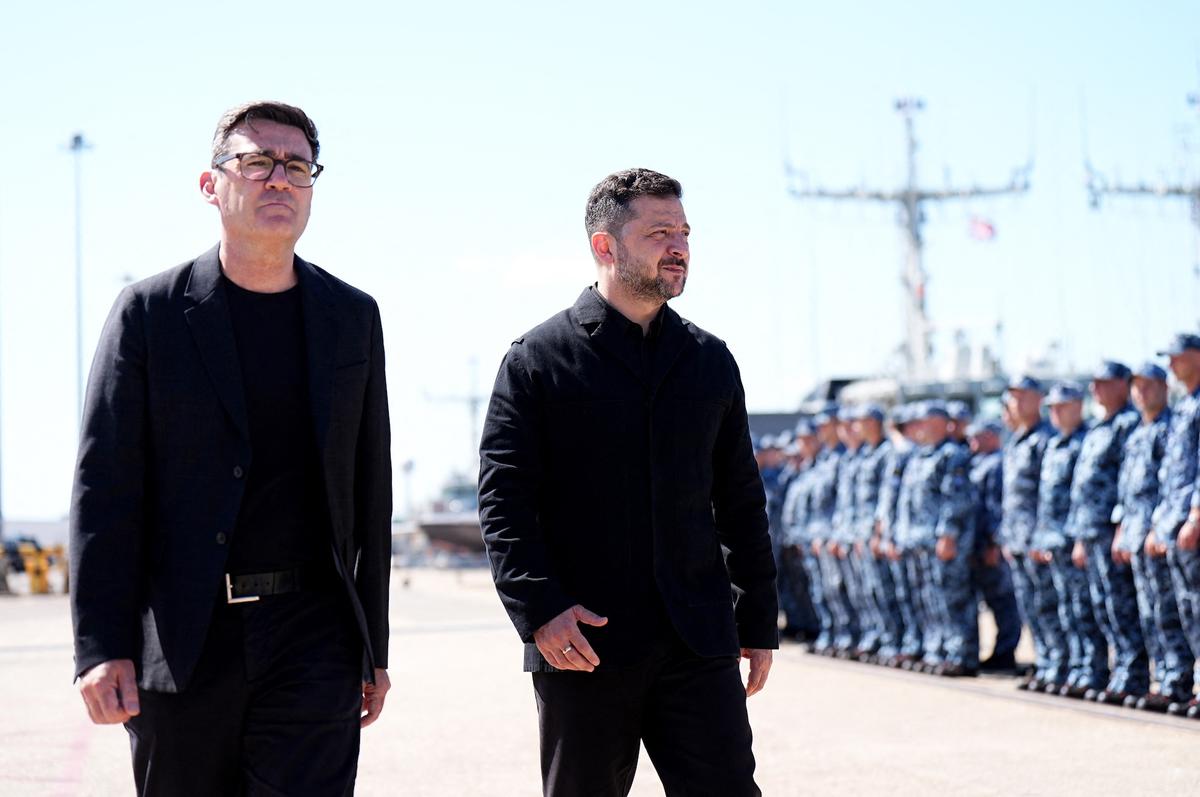
British Prime Minister Andy Burnham (L) walks with Ukrainian President Volodymyr Zelenskyy at a naval base in Portsmouth, England, on July 27, 2026. Aaron Chown/POOL/AFP/Getty Images
Brits are being urged to stock nine liters of bottled water and three days’ worth of food to ensure that they can survive in the event of a weather, cyber, or other critical emergency.
Parents with babies are advised to keep a supply of essential products, while all households are urged to have blankets, cash, a first-aid kit, a flashlight with batteries, and a wind-up FM radio.
‘Not About Panicking’
In an interview with BBC Radio 5, Burnham was challenged over the fact that members of his own government appeared not to be treating the advice to prepare for emergencies seriously, including Housing Secretary Angela Rayner.
She joked in an interview with Times Radio that her emergency box would include mascara, concealer, a bottle of white wine, baked beans, and a tin of custard.
The prime minister told the BBC he would personally stock up on canned goods, including baked beans and soup, as well as Twiglets, a crispy snack.
Burnham said: “It’s not about panicking. … It’s about just taking sensible measures to have enough in the house to tide you over should there be a difficult situation,” adding that unexpected events, “sadly, in the world that we’re in, are becoming more likely.”

Sir Ken McCallum, director general of MI5, speaks at Thames House, the headquarters of the UK’s Security Service in London, on Oct. 13, 2026. Jonathan Brady/Getty Images
Earlier this month, Sir Ken McCallum, the director general of domestic intelligence agency MI5, called for a “whole-of-society effort” to protect the UK against threats to national infrastructure, warning that hostile states could exploit vulnerabilities in the country’s financial systems, energy grids, and supply chains.
Russia ‘Aggressor Number One’
Speaking on Oct. 13, McCallum said the risks were likely to persist in a more contested geopolitical environment compared with the relative stability after the Cold War ended.
He said that Russia “remains aggressor number one,” and that the Kremlin “continues to lash out at the UK and its allies.”
The MI5 chief said the Russian military and intelligence services were “once again escalating their attempts at hybrid warfare—being careful to stay below the NATO Article V threshold [that] it would be foolish for them to cross.”
“This means Russia is using tactics that stop short—though sometimes not much short—of conventional conflict,” he said.
“To stand up to the pressure our adversaries are trying to put us under, we need to build a ‘team of teams,’ not just between different bits of government, but as a true whole-of-society effort.”
McCallum warned that infrastructure designed for efficiency could be vulnerable to malicious disruption. He gave examples including a banking-app hack that could lock people out of their accounts, a drone attack on an airport runway leaving travelers stranded, and a cyberattack on a local hospital, delaying treatment.
Kremlin spokesman Dmitry Peskov has repeatedly denied accusations that Russia is trying to destabilize the UK or the European Union. On Sept. 23, following Burnham’s speech at the United Nations accusing Moscow of spreading disinformation, Peskov accused the British government of “stoking anti-Russian sentiment and fostering an atmosphere of total Russophobia.”