
British Prime Minister Keir Starmer (C) attends a meeting with campaigners to discuss historical forced adoption, at Downing Street, in London on July 2, 2026. Isabel Infantes/Pool Photo via AP
British Prime Minister Sir Keir Starmer has apologized for a system of forced adoptions that targeted unwed mothers for decades after World War II.
“On behalf of the whole country, I say it to every single person impacted, we are deeply and profoundly sorry,” Starmer said in a statement to the House of Commons on July 2.
Around 185,000 children born to unmarried women between 1949 to 1976 were put up for adoption under a system created by the British state and churches, often through coercion.
“The State did not do enough to protect mothers, children and families from harm,” the prime minister said. “And for this systemic failure, I am truly sorry.”
Starmer said that many single mothers who were young, vulnerable, and without support “were coerced, bullied or misled into feeling they had no choice but to have their children taken from them.”
He added that these practices were embedded in systems across the country, including local authorities, health and social care services, parts of what is now the National Health Service, and even across voluntary organizations and churches.
Related Stories

“All institutions that operated with power over people’s lives, yet they did so without compassion, without consent, and without dignity or proper safeguards,” he said.
The prime minister promised the government would fund the development of an online service to allow victims to access adoption records, as well as funding intermediary services to help families reconnect.
Starmer described the forced adoptions as “a stain on our history.”
Church of England Apologizes
The government’s apology follows one from the Church of England last month over its role in forced adoptions.
Archbishop of Canterbury Sarah Mullally said in a June 18 statement on behalf of the church that it was “profoundly sorry for the pain, trauma and stigma experienced—and still carried—by many people because of historical adoption practices in homes affiliated to the Church of England.”
The church’s role was in practice through the running of “mother and baby homes,” where unmarried women were sent during pregnancy or after giving birth and being separated from their babies—a similar practice run in the Republic of Ireland by the Catholic Church.
A report published by the Church of England on historical adoption practices said incidences had been reported “of what has been described as ‘forced adoptions’, where unmarried mothers have expressed feeling unsupported in making decisions about whether to keep their baby, or in some cases have described being separated from them against their will.”
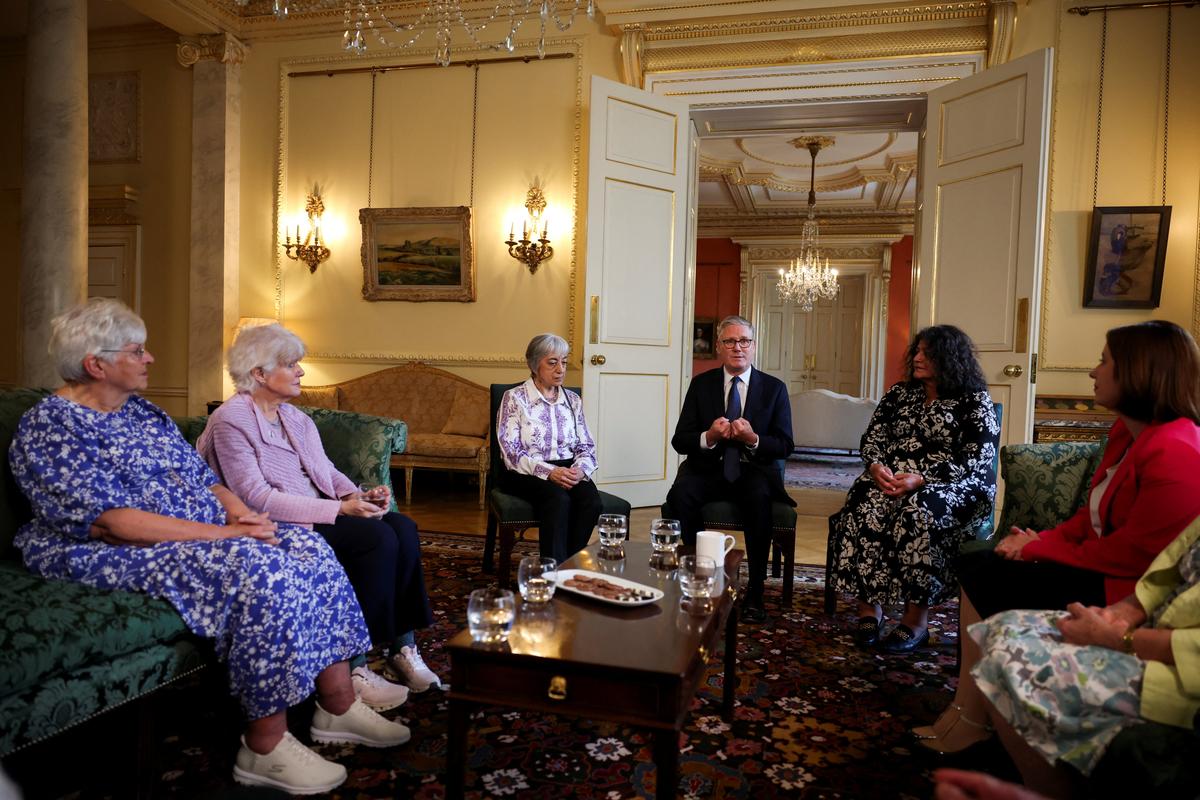
British Prime Minister Sir Keir Starmer attends a meeting with campaigners to discuss historical forced adoption, at Downing Street, in London on July 2, 2026. Isabel Infantes/Pool/Reuters
Mullally said that the church had first-hand accounts of women whose babies had been taken from them “in circumstances where they had very few meaningful choices.”
As a form of “correction,” many women and girls were forced to carry out menial and manual labor at these homes.
“All of this took place in a society that often valued secrecy and respectability over compassion and care,” Mullally said. “The Church of England was part of that society and helped to sustain those attitudes.”
“While homes were encouraged to keep mothers and babies together, this often did not happen.”
Coercion
A separate report in March from a House of Commons committee in the UK Parliament said the treatment of these expectant mothers, many of whom were under the age of 18, during their pregnancy and labor was “inhumane.”
The committee heard testimony from two mothers whose children had been taken from them, neither of whom gave consent for the children to be adopted.
“Our evidence from academics suggests that this was the norm,” the report said.
One professional witness, Michael Lambert from Lancaster University, said that “coercion was baked into the entire system,” and that officials misrepresented and masked how decisions were made to give the impression that mothers had made informed decisions and proper consent had been obtained to adopt their children.
“According to Dr Lambert, the power held by the state, social workers and religious bodies meant that ‘consent was pretty hollow, vacuous and meaningless throughout,’” the committee report said.
“He characterised the system as one ‘designed to supply infants to adoptive families’, rather than to support mothers in making a genuine decision about the future of their baby.”